“Please no closer, mom…”

IMG_4576.JPG

My dog is, if I do say so myself, is genetically superior. Descended from long lines of sweet, obedient and wickedly smart Golden Retrievers and Labrador Retrievers, he is smart, devoted, and hard-working (as long as he gets his beauty rest!) He is, however, missing one pretty crucial and breed-defining characteristic: he despises getting wet. If it is raining (which is rare these days, California seems to be in a permanent drought), he eagerly waits for me to put on his raincoat, huddles close under our large golf umbrella (when I can use it, it’s hard with strength and coordination issues to manage both dog and umbrella!) and generally hopes this wetness will be over soon. Somewhere, his water-retrieving ancestors are ashamed. He can lay by the pool on a loose leash with no fears he will jump in. I think he tries to pretend the water isn’t there! I see photos of doggie pool parties, and wonder what would win out: peer pressure or lack of desire to get wet?!

We spent last weekend at the beach, I ventured into the water a bit (mostly the pool, the ocean was a bit cold!), Cassius kept watch from the safety of his blanket, undoubtedly hoping that he would not be required to do anything involving getting wet. Luckily for all involved, he ended his weekend dry and relaxed.

IMG_4610.JPG

But his look in the first photo is hysterically accurate “The nice warm sand is perfectly fine – please no closer to the water, mom…”

Bring Cara Back! Stolen Service Dog!

Alex's avatarHelp On Four Legs

Imagine experiencing severe anxiety over the smallest unknowns or changes in your plans. Some of you might not have to imagine it because it’s real for you, but for the rest of us, it’s difficult, maybe impossible, to simulate.

For 9-year-old Otto, anxiety is a manifestation of autism, and it can make it impossible for him to function. Variables that seem small to most of us can make or break his day, and his one constant is Cara, his Skilled Companion (a type of assistance dog) from Canine Companions for Independence. Tragically, she was stolen on Friday afternoon, and his family is desperate to find her.

10686998_10204953244453781_4807927868466818406_n

Above: Cara rests her head on Otto’s chest. Otto smiles; Cara has a look of contentment.

Cara was last seen at her family’s home in La Jolla, California, on Friday afternoon. She is not microchipped, nor is she wearing a collar, due to a hot…

View original post 341 more words

Awareness & What It Means

This month is, super-coincidentally, an awareness month for 2 conditions I have – a craniofacial condition (Moebius syndrome) & alopecia, a much more common autoimmune disease.

IMG_4510.JPG

Besides the fact that I’m a bit bewildered by the fact that there are two different craniofacial months each supported by different organizations, I think it’s great to see what various organizations are doing and how they incorporate other organizations to spread the word.

The American Girl company posted a great photo of their “wigless” dolls – perfect for young girls with alopecia or who are undergoing cancer treatments. I loved that it was important enough to feature.

IMG_4512.JPG

I seeing RJ Palacio, who wrote the children’s book Wonder – about a boy with a craniofacial condition – speak tonight and I really think she does a lot to spread the word about craniofacial conditions. Or at least I think it could, so I hope it continues to spread both her message about kindness and about awareness for craniofacial conditions.

Found this in my recent read

It’s fascinating when I find mentions of things I’m interested in (in this case, craniofacial differences) in a book completely unrelated to the topic. I loved this description, too , quite apt. Plus I just really love JK Rowling ‘s writing, whether it’s in her children’s books or her adult mysteries written under a pseudonym.
IMG_4107.JPG

International Assistance Dog Week

20140805-070550-25550838.jpg
This week marks International Assistance Dog Week. I think it’s a great idea to make us think more broadly, and more compassionately, about the entire assistance dog community. I recently had a sort-of encounter that made me reconsider this.

Normally seeing other working dog teams out in public is nice. There is the moment of acknowledgement, the admiring of both dogs behaving themselves, and then going on our own separate ways. Often this is done without so much as a word between the two handlers, just a communal acknowledgement. (Unless it’s a fellow CCI handler/raiser/volunteer, then you end up discussing breeding and raising and who trained the dog in Advanced Training!).

Last week, though, I had my first “bad” encounter with another service dog handler, and I was honestly a bit shocked. I was at my local independent grocery store, checking out the prepared food. Cassius was standing between me and the counter. Guide dog and handler come barreling down the aisle behind me (aka, before I had time to react!), dog sticks its nose in Cassius’ face on the way past. Cassius rocked a pretty darn good “leave it”, guide dog got a stern forward. All good, right?

Apparently not. As I was checking out, I heard the handler asking the cashier if they knew there was another service dog (in a blue vest. Hello, if you gave enough vision to see the blue vest, how about seeing the big honking yellow dog in said blue vest?!) in the store… “And if they knew if it was a real service dog?” Sigh. Thankfully I buy a lot from said grocery store and they know I’m almost always there with Cassius, so they stood up for me… But it was rather bizarre.

So what can be learned from this? Education! Education for other service dog handlers (yes, there are indeed other types of service dogs besides the kind that you have!). Education for the public about fake service dogs so that the default question isn’t “are they a faker?” And education for businesses so more can make good judgements like this one did.

And while we’re at it, how about some education for your dog so it doesn’t sniff things on the way past. 🙂

Sidekicks: Natalie & Cassius

Photo by Melanie Riccardi

Sidekicks: Natalie & Cassius

Cassius and I were part of a photo project showcasing the relationship between people and their service dogs, and this is the first of a few installments of our blog. I’m so excited to have this opportunity to share my beautiful dog with the world.

Thanks to Alex Wegman for her idea & writing skills, and Melanie Riccardi for her amazing photography! She captured Cassius’s personality so eloquently. 

I can’t wait for the next blogs!


24th Anniversary of the Americans with Disabilities Act

20140726-093637-34597812.jpg
The ADA was signed 24 years ago today. While I was definitely too young to remember life pre-ADA for people with disabilities, I know I have benefited from growing up in a post- ADA and post- IDEA society. It’s not perfect for people with disabilities, of course, there are still huge barriers and challenges – but progress has been made and is only continuing.

I loved the message of this graphic – it’s so true! Disability rights are indeed civil rights.

Change how you see, See how you change

Change how you see, See how you change.

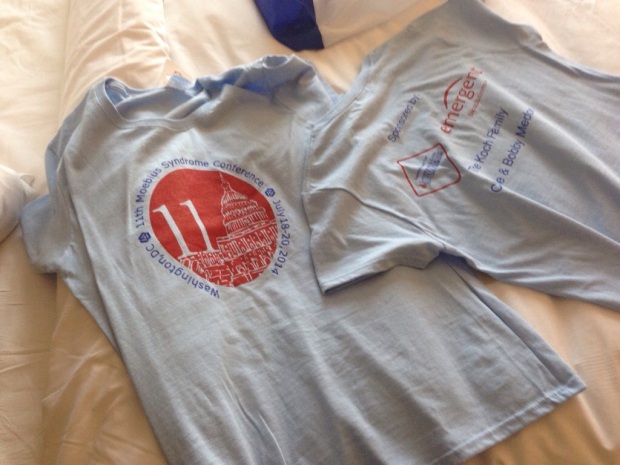
Rick Guidotti uses this as his overarching theme for the Positive Exposure project, and the 11th Moebius Syndrome Conference this past weekend reaffirmed the power of this statement for me. As much as his project is about changing how people from outside of the disability community view people with different medical conditions, the perhaps surprising power of the project is really empowering people from within.

I love seeing children and adults, many of whom have faced teasing or worse at one time because of how they look, light up before his lens. I love how he, to use his own words, treats every subject he photographs the same way he treated supermodels. Empowerment is perhaps an overused concept, but witnessing and being part of his creative genius is truly empowering.

I think that empowerment is why I come back every 2 years to Moebius Syndrome Conferences. The community, my friends. The medical information, while always fascinating, is secondary. It’s a bit disarming, in the best way possible, every time… to suddenly be surrounded by people like me – to have it re-normalized, if only for four days every two years in July. It takes you aback, in a way.

But I love seeing the groups of pre-teens roaming the conference hotel in search of adventure, the younger children making friends and meeting children who look like them for the first time, and the incredible community of adults with a wealth of experience and knowledge. I even love the talent show… even if we did witness every possible rendition of “Let It Go” (some even complete with costume!).

It’s about the exposure to different people going through some of the same things I am, and learning from them. It’s about changing how I think about things and how I approach life with Moebius syndrome. It’s about seeing myself evolve over time as a person and as an advocate. It’s about introspection, and about socializing over drinks with our ears still ringing from talent show performances. It’s about history and shared experienced, and it’s about the future.

I am excited about what’s to come after every Conference, and this one was no exception! Looking forward to the FRAME video project explaining Moebius syndrome, applying to be a Pearls Project Ambassador, and about all the exciting research to come!

And very excited about having the 2016 Conference in Los Angeles… can’t wait to go to Disneyland again! And the beach!
20140723-130226-46946000.jpg

Wordless Wednesday: July is National Cleft & Craniofacial Awareness & Prevention Month

20140702-175300-64380192.jpg
www.nccapm.org

So for some reason I’m not entirely sure of… we get 2 months for craniofacial awareness. Yay? Anyway, this is July’s logo and information! Check it out, and if you don’t know much about craniofacial conditions check the supporting organizations and learn about the diverse conditions, some you’ve heard of (cleft lip, for example) and many you have not (Moebius syndrome, other conditions such as Apert syndrome). Spreading the word about awareness of craniofacial conditions is needed, as these are often misunderstood and not really covered by the broader disability community.