Visible Differences and the #ToyLikeMe Movement


A few years ago, I was part of a group in charge of choosing teddy bears to sell at the Moebius Syndrome Conferences. We found that it was actually really, really difficult to find a non-smiling teddy bear! Finally we found a neutral-mouthed teddy bear that we chose. 

Makies, a British company, is among a group of advocates and manufacturers embracing the #toylikeme movement – offering customizable 3D printed dolls for sale. I’m actually not really a fan of the heads they use (those eyes are kind of creepy!) but I love the concept.

I probably would have loved more dolls with differences like mine growing up – I was always playing hospital with my Playmobils and loved it when my American Girl dolls came back from the “hospital” (aka with a new head after the hair was beyond repair!) wearing hospital gowns! I don’t think I was necessarily harmed by not having toys that looked like me, but would have loved to have this available to me. 

I like that companies are embracing both diversity and customization at the same time – with the advent of technology like 3D printers I really see things like dolls with more involved facial differences being available very soon.

I hope next time I’m seeking a non-smiling teddy bear the toy landscape will be kinder to children with visible differences.

SufferIng

In case you ever need to know, the sure-fire way to seriously piss me off is to tell me that I am suffering from Moebius syndrome.

The people of Nepal are suffering. People and families who are going hungry or experiencing great trauma are suffering.

I am living, not suffering.

Yeah, it sounds like I’m just being really picky… but for me, and for many others living with chronic conditions of all kinds, that distinction defines so much. It defines how you approach me, how you approach the fact that I happen to have a rare medical condition.

If (the general) you approach my having Moebius syndrome as suffering, I immediately feel on guard. On guard for what, I’m not sure – pity? condescenting-ness? mid-understandings?

Perhaps I need to work on seeing the other side of things and think in terms of educational opportunities and different life experiences and such… but I don’t always have the energy for that.

I’m too busy living with Moebius syndrome. 


Bruises Aren’t in Style

I am clumsy. Everything is usually slightly blurry. This combination usually leads to me crashing into at least a few things a day… and I often have the bruises to prove it.

Tomorrow I have a potentially-important interview for a promotion (well, actually to get on the list for upcoming opportunities within the higher promotional class). I’m of course a little nervous, I want to get a good ranking and do well… and now I’m concerned also about covering up this ridiculous bruise on my knee! Because of course I need other, random, non-work-related things to worry about!

Maybe that’s what’s really salient about life with a chronic condition – these “extras” that complicate life. The things you worry about that no one else does. There are hidden bruises, too – experiences unique to life with my medical conditions that I carry with me. I carry those, too. Sometimes they hurt as much as physical ones.

Hoping for a good interview and hidden bruises tomorrow, both physical and metaphorical.

IMG_5744-0

IMG_5743-0

Pile O’Awareness, and of History

2015/01/img_0368.jpg

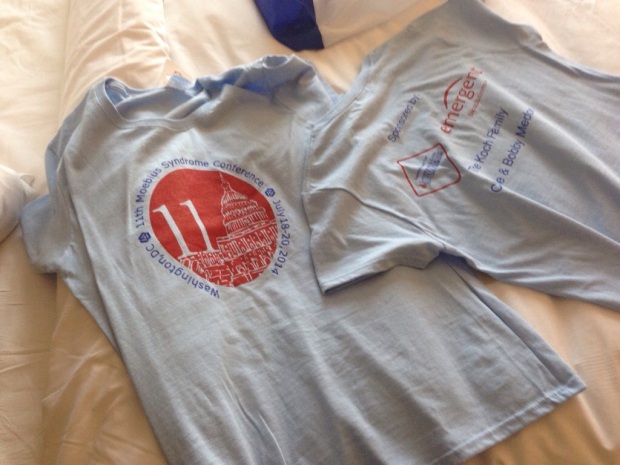
A stack of t-shirts sits on my bed. They span 6 years, the entire United States, and come from a variety of experiences I have had in the Moebius syndrome and rare disease community. Some I wish I could relive, some I wish I could change my response to, some I am still not sure of. But they are all there, sitting on my bed in front of me,

These t-shirts represent communities, constructed by chance, by choice and perhaps by necessity. They are communities that sometimes I wish I could escape, but know I cannot. Communities that have shaped me and supported me and pushed me. Communities that have, most of all, taught me.

January 24 is Moebius Syndrome Awareness Day, commemorating the birth of Paul Julius Mōbius – a German physician in the 1880s who first described the syndrome. It is a time for awareness-raising, of course, but it’s also a time for reflection. About how we navigate the world with a rare disorder, about how we negotiate real-world life with the online community we have formed, about how we raise awareness in everyday life, not just one week a year.

I tend to be more quiet, and approach awareness raising in the same way – open to awareness-raising, but guarded. Probably too guarded, but that’s a post for a different day (or never). Other people are most comfortable doing it in large-scale ways. Both are needed.

All kinds of things are happening this weekend – get togethers, news stories, social media campaigns… I’m spending Saturday day working, and Saturday night undoubtedly catching up with what I’ve missed! I’m looking forward to seeing what is accomplished this year, and what will happen looking forward to next year and beyond.

My friend Kathleen Bogart just published a study about how awareness leads to understanding. And that is what ultimately I think anyone, but especially those of us living with unique medical needs, want. I don’t even care if you can’t remember what it’s called, honestly (best line ever “whatever-it-is-that-you-have-again?)… but understanding is paramount to acceptance. And we all, ultimately, yearn to be accepted. I think I, and others, are doing good work towards that goal.

So this pile of shirts represents a history, my history, with the Moebius syndrome community. It represents me navigating my unique journey. These are my choices, my desires and my mistakes. They are uniquely mine, just like all of the individual experiences living with Moebius shared on Moebius Syndrome Awareness Day.

Together, they make a visual embodiment of a layered story. My story.

2015 in Thoughts

I don’t do New Year’s Resolutions. Just not worth the pressure one puts on oneself. But of course I have lessons from 2014 and hopes for 2015.

Managed to start 2 new jobs in 2014, which I hope doesn’t happen again! Both good moves on my part and I learned a lot from both, but a little too much newness for my liking. I’m nearing the 6-month mark at work, and my instances of “oh %#^+ I have no clue what to do!” are (thankfully) rapidly decreasing. I like the feeling of going into work and basically feeling competent at what I’m doing. I applied to be on the list for a promotion… so, we’ll see.

Non-work things were sometimes great, often tough this year. My grandmother fell in the summer and passed away in the fall. That was rough for my mother and my extended family – even though she was not particularly grandmotherly in that stereotypical way, she was still family. I had 2 horses I was riding become lame and un-rideable. A looked-forward-to trip to New York City had to be cancelled. But, of course, those things are trivial when compared to family.

There was good stuff too – Friends at the Moebius Syndrome Conference, learning how to ride a big 18hh sweetie of a draft horse, a wonderful weekend on the beach at my favorite west coast hotel. In everything, I learned a lot about myself and about life (yeah, that sounds overwrought!)

But 2015 is looking promising… moving to an apartment closer to work and to the barn (and away from some of the anxiety-producing civil unrest) this month, traveling to NYC in February (yes, I will be freezing!), going to a really interesting conference in September. And hopefully moving up in my career.

We shall see what 2015 holds for me.

Change how you see, See how you change

Change how you see, See how you change.

Rick Guidotti uses this as his overarching theme for the Positive Exposure project, and the 11th Moebius Syndrome Conference this past weekend reaffirmed the power of this statement for me. As much as his project is about changing how people from outside of the disability community view people with different medical conditions, the perhaps surprising power of the project is really empowering people from within.

I love seeing children and adults, many of whom have faced teasing or worse at one time because of how they look, light up before his lens. I love how he, to use his own words, treats every subject he photographs the same way he treated supermodels. Empowerment is perhaps an overused concept, but witnessing and being part of his creative genius is truly empowering.

I think that empowerment is why I come back every 2 years to Moebius Syndrome Conferences. The community, my friends. The medical information, while always fascinating, is secondary. It’s a bit disarming, in the best way possible, every time… to suddenly be surrounded by people like me – to have it re-normalized, if only for four days every two years in July. It takes you aback, in a way.

But I love seeing the groups of pre-teens roaming the conference hotel in search of adventure, the younger children making friends and meeting children who look like them for the first time, and the incredible community of adults with a wealth of experience and knowledge. I even love the talent show… even if we did witness every possible rendition of “Let It Go” (some even complete with costume!).

It’s about the exposure to different people going through some of the same things I am, and learning from them. It’s about changing how I think about things and how I approach life with Moebius syndrome. It’s about seeing myself evolve over time as a person and as an advocate. It’s about introspection, and about socializing over drinks with our ears still ringing from talent show performances. It’s about history and shared experienced, and it’s about the future.

I am excited about what’s to come after every Conference, and this one was no exception! Looking forward to the FRAME video project explaining Moebius syndrome, applying to be a Pearls Project Ambassador, and about all the exciting research to come!

And very excited about having the 2016 Conference in Los Angeles… can’t wait to go to Disneyland again! And the beach!
20140723-130226-46946000.jpg

Adventures in research

Sometimes my work life and my volunteer life collide in curious ways. Recently, they collided in a manner that really just left me scratching my head.

I spent nearly a year working for a corporate library, where I obtained (usually scientific) articles for corporate clients from academic interlibrary loan services and scientific journal publishers. When I was approached by the Moebius Syndrome Foundation to help procure a clean copy of an old medical journal article with a very positive outlook on Moebius syndrome (the first of its kind), I naively thought to myself… “how hard can that be?” Well, it turned out to be harder than I had imagined!

I logged on to the Copyright Clearance Center website, inputted all the necessary information… and then I got stymied at the “Permission Type”… there was no category for non-profit use, much less personal patient use. We are not academia, and definitely not business.  Printing out copies for the use of a few patients seemed to be uncategorizable.  So I e-mailed customer service, as I was instructed to do. And waited.

Two months later, I received a message saying they were closing my case because the “request does not fit in with our regular categories”… well, I e-mailed them as instructed to precisely because of this issue! And obviously e-mailing them was not the solution.  Because I work in information science and have a lot of experience in academia, I knew Interlibrary Loan would work as my last resort for getting a copy of the article.  So I used that, through a colleague on the Moebius Syndrome Foundation board who has access through her university, and obtained a cleaner copy. 

Although I feel a bit bad about it, I will have a few copies of this copy (how confusing is this?!) made for the Conference this summer to hand out – even though technically I should get permission (and pay) to do so…. but if the journal publishers and copyright center won’t process my request at all, what am I actually supposed to do?  I really did want that pristine clean copy, too.

The internet has made academic journals easier to access in a way, you can get Google Scholar alerts sent to your inbox daily. But those only send you to abstracts.  Getting from that abstract to a useful and complete article can many times be impossible, due to access issues and personal pay walls.  A Pew Internet study recently found that 1 in 4 internet users online hit pay walls in accessing health information, and even more important in my case – 30% of those living with chronic conditions faced a pay wall when looking online

I don’t know if I could even call what I experienced a pay wall – is not even being able to pay for something because you can’t get anyone to get back to you in a timely manner a pay wall?  I was prepared to have the Foundation pay something for usage… until I saw it going into the $100s of dollars for a few printouts.  So I guess I did kind of hit a pay wall.  Keep in mind, this article was written in 1986, for god’s sake! It’s not like it’s particularly important or relevant from an academic standpoint.

Except it is relevant for patients.  In 1986, my parents had a 3 year-old (me!) with a super-rare condition, they were told there was a very good chance I would never meet anyone else with the same disorder and who knows what else.  Then my (amazing!) pediatrician and geneticist shared this article with them – about a successful professional, a nurse, with Moebius syndrome – living a productive and full life.  It was the first time, undoubtedly, that anything “positive” was published in the medical literature about Moebius.  So it’s important to have and share with coming generations.

As someone who has spent time both in academia and publishing, and now working in information services, and as a patient seeking and sharing medical information (or, an e-patient, as we sometimes are referred to as), I am honestly torn on the concept of open-access journals: I want the information to be readily available for patients, scholars and those in the medical profession, but I understand the needs of the publishing industry to be reimbursed for the time and effort of academic publishing.  So what in the world is a good solution to this? I really don’t know. I’m thinking there should be an avenue for people who do not clearly fit the parameters of either business or academia to request articles for use within patient communities.  I think that would help many people access and share valuable information.
This is a song, for all the good people…

http://www.youtube.com/watch?v=3-2gacuKX4c

NIH Director Dr. Francis S. Collins at the 10th Moebius Syndrome Conference

Honestly my favorite part of the 2012 Conference. I totally teared up. Hope he can make it again to DC this year.

Today is Rare Disease Day, and this song sums it all up for me quite succinctly. It’s about the people I’ve met and continue to meet due to my rare disorders. They transformed my life, gave me my sense of self, connected me to the amazing CCI world… and so much more. I look forward to what else is in store for me on this journey.

Moebius Syndrome Awareness Day

20140124-124835.jpg

I think that the best sort of awareness is spread quite unintentionally, just by living my life and sharing with people who know me and want to know my story.

Every once in awhile, though, a big awareness day thingy makes me happy to be part of this community. It’s amazing how diverse and varied we all are, brought together by chance and through social media.

For more information on Moebius syndrome and MSAD, see http://is.gd/WhatIsMoebius and http://is.gd/MSAD2014.

Chances

Every few months I am overcome by the enormity of chance. I know people have different views on the concept of “why” one happens to have a medical condition (or any other defining life event)… but for me to conceptualize it, it’s just chance. Genetic fluke. Environmental. All of the above. Who knows!

It was simply chance that I was born with Moebius syndrome, and it was chance that I was born where and when and to whom I was born.  For me, those chance occurrences allowed me to have access to access to amazing healthcare and educational resources, a supportive family and community, and the opportunity to be successful.  I know that was mainly just good luck and chance, and I am grateful.

But even more shocking for me, and I think for a lot of us “sheltered” people in first-world countries is that – depending on socioeconomic status and cultural norms – many children are not given that chance. Families aren’t able to pay for healthcare.  It isn’t socially-acceptable to have a child with visible disabilities.  They can’t access necessary resources.  So they abandon these children to state care or the foster system.

Really, really unfathomable. But it happens. It wasn’t that long ago when Western countries did the same (for a heartbreaking perspective, Google “state developmental centers/schools and/or eugenics”).

This post is motivated by a child I just became aware of, “David”. He lives in China and looks so much like so many other boys with Moebius syndrome I know.  He is apparently smart and able to succeed if given the chance.  But not living in the US and being in a large foster home, he does not have access to the same resources and tools that will allow him to succeed.  The chances of him being adopted in China are slim, so he is available internationally.  Taking the chance that someone a world away might see something in him.

I hope someone takes that chance.

(If you are interested in learning more about “David” or other waiting children, see http://www.madisonadoption.com)

Image